


The statements made and opinions expressed in this publication are solely the responsibility of the author(s) and do not necessarily reflect the opinions of the Security in Context network, its partner organizations, or its funders.
By Christian Henderson
Christian Henderson is assistant professor of International Relations and the Middle East at Leiden University in the Netherlands. His research specializes on the politics and economics of the environment and resources in the Middle East and North Africa. His work has previously been published in Antipode, Journal of Peasant Studies, Environment and Planning A, and Globalizations. He is the author of Monarchies of Extraction: The Gulf States in the Global Food System, published with Cambridge University Press in 2026.
Citation: Henderson, Christian 2026. “From Dependence to Interdependence: The Power of the UAE’s Food Sector,” Security in Context Working Paper 26-16. October 2026, Security in Context.
INTRO
The UAE is highly dependent on imported food, and as much as 90% of the country’s food commodities are sourced from abroad. To mitigate this, the UAE has invested in an agribusiness sector that has vertically integrated every stage of production (Henderson, 2026; Koch, 2020; Woertz, 2013). As a result, the UAE is highly food secure, particularly when compared to the rest of the Middle East and North Africa (MENA) region. The country has one of the largest agribusiness sectors in the Arab world, and it sits at the center of value chains that cut across Asia, Africa and beyond. In 2023, it imported foodstuffs with a total value of $23.65 billion and its exports of food were valued at $11.68 billion (OEC, 2026).
One characteristic of this food industry is its close relationship with the UAE state, as many UAE agribusiness companies are partly owned by the state, and benefit from state support. This example of what Philip McMichael describes as “agro-security mercantilism” reflects the trend of growing state involvement in the global food system, which is mirrored in other economic sectors (2013). As a result, there is speculation that we are moving away from the neoliberal era, toward a world that will be defined by these state-led capitals (Alami, 2026).
This paper assesses the relationship between the UAE state and its agribusiness sector in two ways. Firstly, it examines the way in which the UAE state supports the agribusiness industry and uses its levers of aid, investment and diplomacy to secure access for its agribusiness firms. Secondly, this paper explores the strategic nature of the UAE’s food sector. The UAE is economically robust, and it is considered a “middle power.” Its external investments, services economy and its logistics infrastructure allow the UAE state to pursue global agendas. Its networks of trade and investment provide a means for leverage and influence that can mitigate the country’s vulnerabilities.
In this context, the paper argues that the agribusiness sector allows the UAE state to accumulate power, leverage and influence internationally. To conceptualize this aspect of the UAE’s foreign policy, this paper submits that the agribusiness sector creates “interdependence.” The scale of the country’s food imports and exports, the size of the agribusiness sector and the logistical infrastructure that accompanies it, creates a relevance for other states in the region. The UAE economy is a market for exports, and a source of food imports. Its logistical capacity creates connectivity and market access. Its substantial food aid sector also serves as a foreign policy tool of the UAE state, which it uses to balance other agendas.
To make this argument this paper will look at two dimensions of the country’s food sector and the way that it represents interdependence. Firstly, it will illustrate the way in which the size of the UAE’s food trade makes it a major market for large agricultural exporters such as India, and a major source of food imports for other countries in the Middle East region. Secondly, the UAE’s food import complex is enmeshed with the country’s logistics sector, infrastructure that is highly pertinent for the patterns of capital and commodities flow in the Middle East and the Indian Ocean. Access to these logistical corridors is a highly strategic matter for powers such as India and Israel. Finally, the paper briefly assesses how the UAE weaponized this interdependence in its relationship with Qatar.
UNDERSTANDING THE UAE'S POWER
A large body of literature suggests that the UAE has developed into a “middle power” country (Hanieh, 2018; Henderson, 2017; Hvidt, 2009; Krieg, 2023; Ziadah 2019) Given that its military status is relatively limited (in comparison to other similar powers such as Turkey), the UAE’s power rests on its economic position (as well its relationship with the US and other global powers). This is manifest in its oil exports and downstream byproducts, but also its non-oil sectors such as services, logistics and defense. Its foreign policy rests on its external investments, its mediating role, and also its web of armed proxies. As a result the UAE government is active in a number of regional conflicts such as Sudan, Yemen and Palestine.
The UAE’s management of its food import dependence provides an insight into this mode of power. Since the 1970s the UAE has developed large agribusiness conglomerates in order to address its food imports, on which the country relies for around 90% of its commodities. In the last two decades the UAE has taken a more proactive approach to developing this agribusiness sector. With state investment and support, agribusiness companies are leasing land abroad, diversifying global value chains and developing a processing industry within the UAE. This state-led vertical integration of food represents “‘agro-security mercantilism” (McMichael, 2013), a characteristic shared with the food import complexes of other emerging economies such as China. This is a process in which state-led vertical integration is, as McMichael writes, a “kind of ‘re-territorialization’ (that) is designed to avoid dependence on markets, or more particularly, market intermediaries” (ibid: 51). Simply put, these states are seeking direct control of the international food value chain, from the field to the supermarket. The state’s role is manifest in direct control of resources outside of the domestic economy.
How does this industry serve state objectives? Liberal approaches to economic power tend to focus on the role of trade and business influence as a form of soft power (Fukayama, 1992; Friedman 2005). In this framework, the UAE generates power through ensuring the mutual interests of the country that it trades with. It assumes a relative level of parity between the UAE and the other countries with which it maintains bilateral economic relationships. A realist theorization of the UAE’s power assumes a more contentious relationship.
The concept of interdependency helps us understand the power of economic and trade networks, with both liberal and realist interpretations. According to Keohane and Nye, interdependency refers to economic linkages between states in which mutual benefit leads to greater cooperation and decreased conflict (1973). A more realist interpretation argues that interdependency exists within a hierarchy. As a result there is a potential to use linkages for state leverage (Farrell and Newman, 2019). Rather than a flat set of interactions, a realist notion of interdependency assumes an asymmetry within bilateral relations; states that are higher up the hierarchy and are at the center of networks of trade and economic exchange benefit from greater levels of power and leverage than those states at the periphery. According to Farrell and Newman this asymmetry creates the potential for “weaponized interdependency” (2019). This is manifest in the state’s use of interdependence for its own objectives. Power is obtained through control over hubs of connectivity and flows of information.
With this considered, the UAE’s position in the regional food trade is a part of the country’s power projection. Its ability to create networks of dependence and interdependence are part of the project of cultivating networks of elites and government across the region (Krieg, 2023). The UAE state uses food as a sector to fulfil its own agenda of food security and as a means of accumulation. In its relations with countries that are more powerful it uses investment and market access to make itself relevant. In countries that are weaker it uses this economic power as a form of leverage and to exert power. In this context, the country’s food security and its import dependence becomes a means to generate interdependence. The UAE’s policy does not reflect a passive approach to a vulnerability, but rather an assertive attempt to exert control over supply chains to generate market power, and use its trade and investment networks to leverage influence, relevance and specific objectives.
THE POWER OF FOOD TRADE
One defining characteristic of several large agribusiness companies in the UAE is their proximity to the state. Companies such as Al Dahra, Agthia, International Holding Company, Jenaan, and Elite Agro are owned by the state, or have shareholders in the ruling family of Abu Dhabi, the Al-Nahyan. As a result of their ownership and their role importing food, these companies rely on state support. Their portfolio of interests are at the forefront of the UAE state’s diplomatic agenda.
The UAE state creates linkages for these companies through conditions on investment, loans and aid. What is touted as aid for the assistance of development and economic growth often has prerequisites that ensure benefit for the UAE. In 2023 the Egyptian government secured a loan of $400 million from the Abu Dhabi Fund for Development in order to finance wheat purchases. One condition of the loan was that the first transfer of $100 million would be used to buy wheat from Al Dahra, a company that leases 116,000 acres of agricultural land in Egypt for as little as $1 an acre (Alestiklal, 2023). This is not to mention the consumption of water from the Nile and aquifers, which is unmetered.
This bundling of Abu Dhabi’s agendas is evident elsewhere: in Serbia, for example, where Al Dahra leases 22,000 acres of land. This entry into Serbia coincided with Abu Dhabi investments in Serbian real estate, arms industries and the Serbian airline (Barlett et al, 2017). It was also accompanied by a $400 million loan from the Abu Dhabi Fund for Development. In a similar example in 2022 the UAE sought a package in Sudan which included the construction of a new port on the Red Sea, a new road, and a lease on 400,000 acres of agricultural land. The deal would include a $300 million loan from the Abu Dhabi Fund for Development.
The UAE state has encouraged its companies to exert total control over the value chain in a strategy of vertical integration. In some cases UAE food companies control every stage of production, and face minimal exposure to the open market. Al Dahra, for example, is a company owned by members of the Al-Nahyan ruling family, which owns farmland in Egypt and Romania and a number of other locales. The commodities produced on this land are exported directly back to the UAE, where they provide the inputs for Al Dahra’s processing of commodities such as flour, rice and dairy products. According to Al Dahra’s website: “Core hubs like Romania and Egypt provide vertically integrated, high-volume production with full control over farming and processing, ensuring stability even in the face of global shocks” (Al-Dahra, 2024).
How does this trade embody a form of interdependence? In order to appreciate the strategic nature of the UAE’s food systems, we must take into account that the MENA region is the most import dependent region in the world. Gulf states import between 70-90% of their food and other countries in the region such as Iraq and Yemen import the majority of their consumed food. The import dependency of many Arab countries creates a large market for food exporters, and states such as Egypt and Algeria are among the largest food importers in Africa by volume.
This dependence on imports creates a reliance on trade, and the UAE occupies a central position within the regional network of food commerce. Rather than a passive importer of food, the scale of the UAE’s imports and exports of food create interdependency. The UAE is dependent on other states for its food security, but this also functions in reverse. Other states are also dependent on it, both as a market for food exports, and as a source of food imports. The UAE has centred itself within a web of polycentric food trade, a core position that can be used as a means of dependency, leverage and conditionality.
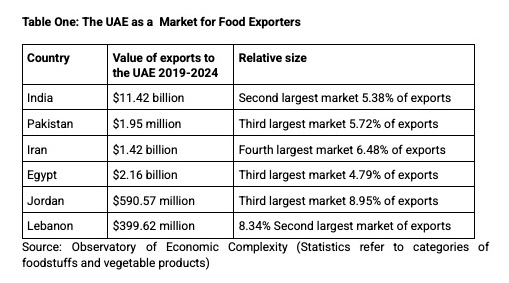
Table One illustrates the scale of food and agricultural imports into the UAE from regional producers. It shows that the UAE is a major market for some of the largest agricultural producers in the region. One striking example is India, a major agrarian economy which exports a total of $37.93 billion of food a year. Of these exports, the UAE is the second largest market with a total of $11.42 billion, this serves the UAE domestic market and is also re-exported (Observatory of Economic Complexity, 2026). This status as a major import market means that the UAE has secured exceptional benefits and guarantees. In 2024, the UAE was exempt from an Indian export ban on onions, imposed due to rising consumer prices (Grain, 2024). Another example is Egypt, for which food accounts almost one quarter of its export earnings. The UAE accounts for around 5% of this, and is the third largest market.
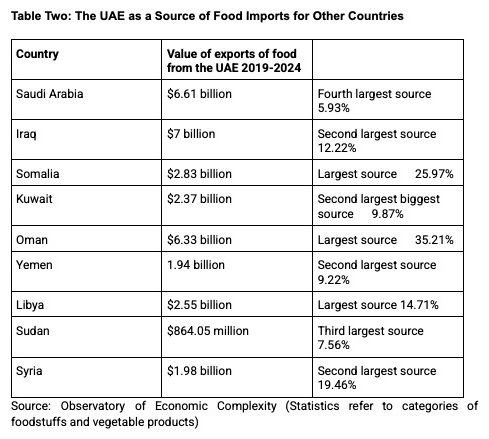
Table Two illustrates the extent to which countries in West Asia and Africa depend on the UAE for their food imports. Apparent is the fact that the UAE is one of the largest sources of food imports for several countries in the region, these include other GCC countries but also poorer countries such as Somalia, Sudan and Syria. This position as an exporter of food is a consequence of the UAE’s position on the regional value chain. It has large exports of processed commodities such as flour, cooking oil, and dairy. One company in the UAE claims to control around 3% of global sugar production (Henderson, 2026).
LOGISTICS, LEVERAGE AND NORMALISATION
Transport logistics are central to the UAE’s food sector. Air and sea freight connect the disparate geographies of supply chains that link the UAE with global agriculture producers. The UAE’s logistical sector is the largest in the region and ensures that food commodities are circulated with the necessary scale and velocity. Jebel Ali Port is the largest in the world outside of East Asia. Dubai International Airport ranks 11th in terms of the volume of air cargo. One characteristic of the UAE’s logistical infrastructure is its multiplicity, and it hosts three major ports that can accommodate Panamax container ships, and four major airports. This depth provides contingency, which is further augmented by the country’s access to both the Persian Gulf sea and the Indian Ocean.
Aside from its immediate role in the food sector, the food-logistics sector is a strategic asset that can be used to leverage political agendas. The size and capacity of the UAE’s logistics systems represent a hub on which other exporters and importers depend. Access can potentially be conditional, and the sector can be used to secure and fortify alignments with other states. One example of this is the I2U2 Group, a cooperation agreement signed in 2022 between India, Israel, the United Arab Emirates, and the United States (Tanchum, 2022). This memorandum is intended to encourage collaboration between these states in a number of sectors, among them food security. This vision mobilizes UAE capital, Israeli technology, and Indian agrarian resources to create a sequence of food trade from India to European markets via the UAE and Israel. This plan was manifested in a pledge by the UAE to invest $2 billion in “food park ” zones that use US and Israeli expertise (Grain, 2024).
The utility of this project became apparent as a result of the Houthi blockade on Israeli shipping in the Red Sea. Following the signing of the Abraham Accords in 2020, the Israeli government promoted the benefit of the agreement to Israeli agriculture, arguing that the UAE would be a significant market for the sector. However the attacks on Israeli shipping by Ansar Allah forces in Yemen, made Israel dependent on imported fresh fruit and vegetables from the UAE, which were mostly transported by road through Saudi Arabia and Jordan and also by air freight. As a result, in 2024 Israel was the biggest market for the UAE’s exports of fruit and agriculture, with a total value of almost $250 million, up from $4 million a year earlier (Observatory for Economic Complexity, 2026). This represented the third biggest source of fruit and vegetable imports for Israel.
The rapid increase in the food trade with Israel as a result of the Houthi blockade, provides market growth but has also deepened the UAE’s relationship with Israel. It provides a rationale for formalizing the land route between the UAE and Israel and investment in rail, road, and free zones. In addition to the economic advantages, this logistics corridor provides a means to impel normalization between Israel and Arab states, a process led by the UAE.
Another form of food infrastructure in which the UAE is gaining a regional foothold is storage. In an import dependent region, food storage facilities provide a means to hedge against the fluctuations and uncertainties of food markets. The UAE state and private Emirati companies have acquired food storage silos in a number of regional markets including Egypt, Jordan and Algeria. Some of these investments include conditions that prioritize the food import needs of the UAE over the host states. In an example of weaponized interdependence, in 2015 the Dubai company Al Ghurair secured the rights to divert grain from its silos in Egypt to the UAE in the event of a crisis (Scott, 2015).
Another example of the food logistics sector’s strategic interdependence is the UAE’s aid sector. The International Humanitarian City (DIHC), a Dubai freezone in which the offices and warehouses of international organizations such as the World Food Programme are located, is one of the largest facilities of its type in the world. This combination of food aid and its logistics sector makes the UAE well-placed to control flows of food aid and use them as a form of leverage. There are reports of the UAE using aid as a channel for supporting armed proxies in Yemen and Sudan (Suliman, 2026).
In this context, the UAE is one of the largest donors of aid to the Palestinian Occupied Territories (OPT) and particularly Gaza. In 2025 the UAE gave a total of US $747 million in food aid to the OPT (UN OCHA, 2026). Food aid deliveries are undertaken in close coordination with the Israeli military. When the UAE and other countries were undertaking air drops of food and other aid over Gaza, the Israeli military provided coordinates of suitable drop sites (Alkhatib, 2025). The UAE’s commitment to this food aid program for Gaza reflects the strategic importance of Palestine for the UAE. Through this aid program the UAE can gather intelligence, coerce Palestinian politics, balance its close relationship with Israel and ensure that it benefits from a reconstruction process (should it take place).
THE QATAR BLOCKADE: WEAPONIZED INTERDEPENDENCE?
How does the UAE use this form of interdependence for more explicit political objectives? Can this interdependence become weaponized? The clearest example of this is the conflict between Qatar and the UAE in 2017: a case that shows weaponized interdependence to be a complex dynamic that can incur costs, particularly for those countries that are highly integrated by trade relations.
The UAE, Saudi Arabia and Bahrain broke diplomatic ties with Qatar and closed their air and sea borders in June 2017. As a result the import of food from the UAE and Saudi Arabia stopped and Qatar began to experience shortages of milk and sugar. Photos of empty supermarket shelves appeared online and foreign companies in Doha advised their staff to stock up on commodities. This was a sensitive issue for the Qatari authorities as they were keen to maintain a mood of normalcy and stability. In the long term, the Qatari government created alternatives, and the UAE and Saudi Arabia lost market share but the incident showed how food exports lead to a dependency that can be weaponized if necessary.
Although the UAE closed its borders with Saudi Arabia, there is no evidence that the UAE explicitly banned food exports to Qatar, nor did Qatar ban Emirati imports. Qatar announced that it would not allow imports of goods from Saudi Arabia and Qatar due to its closed borders prohibiting the required regulatory checks (Reuters, 2018).
One reason for this ambiguity is that both countries are signatories to the World Trade Organization and an explicit export ban would have contravened the terms of this agreement. As a result the overt weaponization of the food trade appeared to be implicit and was denied by both sides. Qatar’s reference to standards and regulations creates a justification that would not contravene WTO regulations. In a statement in 2019 the Qatari government denied that it had introduced a ban and said that it remained committed to the principles of the WTO. According to a government official: “Emirati exporters may be suffering because they cannot export to Qatar, but responsibility for that lies with the Emirati authorities’ export restrictions, rather than with any measures taken by Qatar,” (Government Communications Office, 2026).
This scenario reflects a disincentive to weaponize food trade directly. Aside from the commitment to the WTO, the UAE has an economic interest in maintaining market share for its food sector. The country’s food industry and its exports contribute to the non-oil economy and play a role in economic diversification. As a result, the blocking of food imports and exports can be damaging. Indeed despite the current state of war between Iran and the UAE now, there has been no announcement by the UAE of a trade ban with Iran.
Forms of leverage, therefore, may be disguised as technical regulatory practice. Over the last decade the UAE has implemented numerous bans on agricultural imports from several countries in the Middle East, often due to concerns over the use of pesticides. This ban provides a means to discipline suppliers and it is particularly effective for producers that rely on access to the large UAE market. In 2017 Jordan was subject to a ban and the government moved quickly to reassure the UAE that the country’s produce met the required standard and the ban was lifted within months. Although this is ostensibly non-political, it is possible that there were underlying political motives behind these bans.
CONCLUSIONS
This paper has examined the relationship between the UAE state and its agribusiness industry, and how the state supports the sector. It frames agribusiness as an economic sector that provides the UAE with strategic weight across the region. For a country that does not have a major military, when compared to other middle powers, its ability to leverage economic networks is an important means to maintain a regional standing. Food is one example of this, and the same could be applied to its other economic sectors.
In the future it is possible that this interdependence could become more weaponized. The US-Israeli attack on Iran, which embroiled the UAE and other Gulf states, has potentially introduced a new paradigm. While trade networks and the power of interdependency is likely to continue, the conditionality of investment and trade may become more emphasized. Iran’s control over the Strait of Hormuz illustrates the way that free trade and passage is no longer guaranteed and becomes a matter of discretion. In this new phase, in which global and regional geopolitical frictions become more unequivocal and antagonistic, states such as the UAE may increase the leverage they can gain from their economic networks. Another scenario that may result in the UAE using its food trade network in order to serve sovereign interests is climate change. The prospect of market instability as a result of declining food yields in a warming climate may force the UAE to use its food investments for its own state interests rather than to maintain its position within a liberal system of food trade.
References
Al-Dahra (2024). How US-China Tariffs Disrupted Alfalfa Trade—and Al Dahra Secured Global Supply with a Multi-Origin Model. Al Dahra. https://sl1nk.com/olgzohj
Alami, I. (2026). Non-Hegemony. Phenomenal World. https://phenomenalworld.org/analysis/non-hegemony/
Alestiklal (2026). What Is the Story Behind the ‘Agricultural Scandal’ Between the UAE and the Sisi Regime? Alestiklal. https://www.alestiklal.net/en/article/what-is-the-story-behind-the-agricultural-scandal-between-the-uae-and-the-sisi-regime
Alkhatib A. F. (2025, Sept. 23). Dispatch from 2,200 feet over Gaza: What I learned from airdropping desperately needed food aid. Atlantic Council. https://sl1nk.com/q7y3xtt
Bartlett, W., Ker-Lindsay, J., Alexander, K., & Prelec, T. (2017). The UAE as an Emerging Actor in the Western Balkans: The Case of Strategic Investment in Serbia. Journal of Arabian Studies, 7(1), Article 1. https://doi.org/10.1080/21534764.2017.1322753
Grain (2024, July 3). From land to logistics: UAE's growing power in the global food system. Grain https://grain.org/en/article/7170-from-land-to-logistics-uae-s-growing-power-in-the-global-food-system
Government Communications Office (2019, May 29). Suffering borne by Emirati exporters results from the UAE’s own coercive trade measures targeting Qatar and Qataris. Government Communications Office. https://sl1nk.com/4de8plf
Farrell, H. Newman A. L. (2019). Weaponized Interdependence: How Global Economic Networks Shape State Coercion. International Security; 44 (1): 42–79. doi: https://doi.org/10.1162/isec_a_00351
Friedman, T. L. (2006). The World is Flat : the Globalized World in the Twenty-First Century. Penguin.
Fukuyama, F. (1993). The End of History and the Last Man. Avon Books.
Hanieh, A. (2018). Money, markets, and monarchies: The Gulf Cooperation Council and the political economy of the contemporary Middle East. Cambridge University Press.
Henderson, C. (2017). The UAE as a Nexus State. Journal of Arabian Studies, 7(1), Article 1. https://doi.org/10.1080/21534764.2017.1310534
Henderson, C. (2026). Monarchies of Extraction: The Gulf States in the Global Food System. Cambridge: Cambridge University Press.
Hvidt, M. (2009). The Dubai Model: An Outline of Key Development-Process Elements in Dubai. International Journal of Middle East Studies, 41(3), 397–418. doi:10.1017/S0020743809091120
Keohane, R. O., & Nye, J. S. (1989). Power and interdependence. Glenview, Ill. London.
Koch, N. (2021a). Food as a weapon? The geopolitics of food and the Qatar–Gulf rift. Security Dialogue, 52(2), Article 2. https://doi.org/10.1177/0967010620912353
Krieg, A. (2024). Security assistance to surrogates – how the UAE secures its regional objectives. Mediterranean Politics, 29(4), 454–477. https://doi.org/10.1080/13629395.2023.2183659
OEC. (2022). The Observatory of Economic Complexity | OEC. OEC - The Observatory of Economic Complexity. https://oec.world/
McMichael, P. (2013). Land Grabbing as Security Mercantilism in International Relations. Globalizations, 10(1), Article 1. https://doi.org/10.1080/14747731.2013.760925
Reuters (2018, May 27). Qatar bans goods from UAE, Saudi as embargo anniversary approaches. Reuters. https://www.reuters.com/article/business/qatar-bans-goods-from-uae-saudi-as-embargo-anniversary-approaches-idUSKCN1IS06N/
Scott, A. (2015, February 9). Al Ghurair adds to storage capacity with grain silos in Egypt. The National. https://www.thenationalnews.com/business/al-ghurair-adds-to-storage-capacity-with-grain-silos-in-egypt-1.29021
Suliman, M. (2026 Jan. 14). UAE leverages humanitarian aid to advance its interests. Middle East Monitor. https://www.middleeastmonitor.com/20260114-uae-leverages-humanitarian-aid-to-advance-its-interests/
Tanchum, M. (2022, July 27). The India-Middle East Food Corridor: How the UAE, Israel, and India are forging a new inter-regional supply chain. Middle East Institute. https://www.mei.edu/publications/india-middle-east-food-corridor-how-uae-israel-and-india-are-forging-new-inter
UN OCHA Financial Tracking Service (2026) United Arab Emirates, Government of 2025. https://sl1nk.com/l13raua
Woertz, E. (2013). Oil for food: The global food crisis and the Middle East. Oxford University Press.
Ziadah, R. (2019), Circulating Power: Humanitarian Logistics, Militarism, and the United Arab Emirates. Antipode, 51: 1684-1702. https://doi.org/10.1111/anti.12547


